A roof plumber turns up at a Templestowe house, climbs a ladder, and spends the next forty minutes somewhere most owners never see. Along the ridge. Down into the valleys. Around every penetration where something pokes through the tiles. Homeowners booking that visit usually have one leak in mind. What comes back is a picture of the whole roof, because a leak almost never stays where it started, no matter how convinced you are that it does.
An inspection like this isn’t a glance from the ground with a pair of binoculars, and it isn’t the same job as a roofing crew doing a re-point or a wash. Roof plumbing Templestowe homes need is closer to a health check than a clean-up — checking the parts that actually stop water getting in, not just the parts that make the roof look tidy.
Where the Inspection Actually Starts
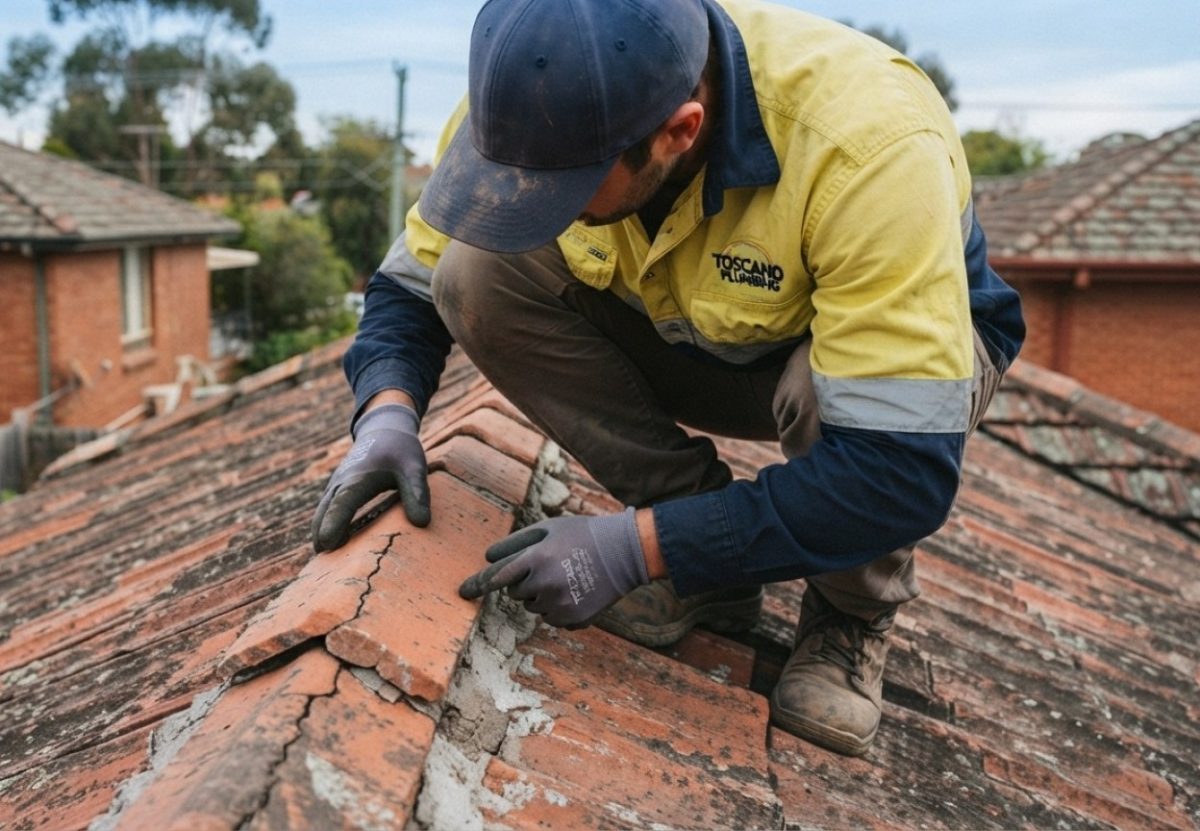
It starts at the ridge capping, not the gutters. Ridge capping is bedded and pointed with mortar that flexes and cracks over decades, and a lifted or hollow-sounding cap is one of the first signs a roof’s ageing faster than it looks. A plumber taps along the ridge, listening for that hollow give underneath. Cracked bedding gets noted. So does how the capping sits against the tiles either side of it. Only then does anyone move on. On a lot of Templestowe roofs, that mortar was last touched whenever the house was built, which for plenty of these homes is close to fifty years ago.
From there it’s every penetration — vent pipes, aerial mounts, solar brackets, anything that punches a hole through the tile line. Each one has its own flashing collar, and each collar is a small, separate point of failure that has nothing to do with the tiles around it. A roof can be structurally sound in every other respect and still leak at a single vent flashing that perished years before anyone noticed. Solar installations added after the original build are worth a specific look here, since the flashing around a bracket is only as good as whoever fitted it, and that’s rarely been a roof plumber.
Checking the Parts That Carry Water
Valleys and box gutters get checked next, because they carry the most water and take the most punishment. A plumber lifts the tiles along the edge of a valley to look at the metal underneath, not just the visible surface, since fixings and lap joints fail from below before anything looks wrong on top. Where a house backs onto established trees, this is usually where the most debris turns up, and a valley that’s been quietly damming water for a season looks almost identical from above to one that’s draining properly.
Downpipes and overflow points get traced back to where they actually discharge. A roof can be doing everything right up top and still send water somewhere it shouldn’t, if a downpipe’s blocked or come loose further down. That step gets skipped more than it should. Following pipe past the gutter line isn’t as satisfying as staying up on the roof, apparently.
What a Written Report Actually Covers
A proper inspection ends with more than a verbal “it’s fine” or “it needs work.” A written report should note the condition of the ridge capping, flashing at every penetration, valley and gutter condition, and any timber underneath showing signs of past water damage — with photos against each item, not just a summary line. For anyone buying or selling in the area, that same report doubles as a pre-sale document, giving a real estate agent or a buyer something concrete rather than a guess.
The report also flags anything urgent versus anything worth monitoring. Not every hairline crack in ridge bedding needs fixing this month, and a good inspection says so plainly instead of turning every finding into a job.
Why This Matters More in an Established Suburb Like This
A roof built in the 70s or 80s has had a lot more chances to develop small, separate faults than a newer build. Different tradespeople over the years. Different repairs. Penetrations added for things that didn’t exist when the roof first went up. An inspection on a house like that isn’t checking whether the roof is old. Everyone already knows that part. It’s checking which of a dozen small failure points has actually started letting water through, and which ones still have a few years left in them. Fix the flashing now, or replace a section of ceiling later. That’s really the whole choice.